The Bristol stool chart, and what each type actually means
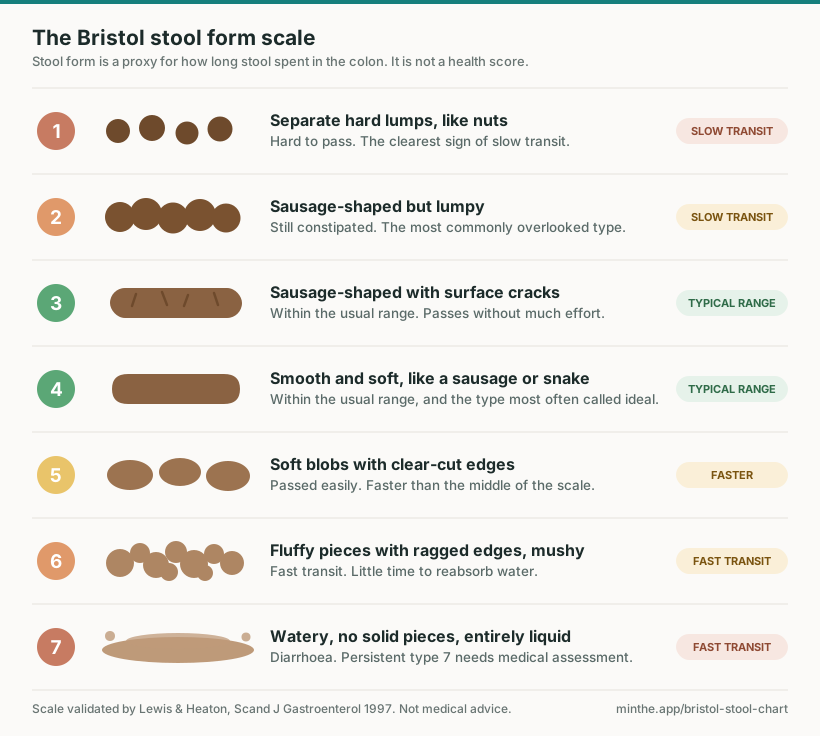
The seven types
Separate hard lumps, like nuts, hard to passSlow transit
The strongest single indicator of constipation on the scale. Stool has sat in the colon long enough for most of the water to be reabsorbed.
Often comes with straining, a sense of incomplete emptying, and pain. Frequent type 1 is worth a conversation with a clinician rather than an indefinite laxative habit.
Sausage-shaped but lumpySlow transit
Still the constipated end. Transit is slow, though less extreme than type 1.
This is the most commonly under-recognized type. People often report their bowels as "fine" while consistently passing type 2.
Sausage-shaped with cracks on the surfaceTypical range
Within the usual range. Passes without much effort.
Types 3 and 4 are what most guidance points at, but treat that as a rough target rather than a rule. Plenty of people are well outside it and perfectly healthy.
Smooth and soft, like a sausage or snakeTypical range
Within the usual range, and the type most often described as ideal.
If you are chasing a target, this is the one. It is not a health score, though. Consistency of your own pattern matters more than hitting type 4 every day.
Soft blobs with clear-cut edges, passed easilyFaster transit
Faster than the middle of the scale. Common and frequently unremarkable, but it is the first step toward the loose end.
Often associated with lower fiber intake. It becomes more informative when it appears alongside urgency or a change from your own usual pattern.
Fluffy pieces with ragged edges, a mushy stoolFast transit
Fast transit. The colon has not had time to reabsorb water normally.
Frequently reported after a trigger food, during a flare, with stress, and in the diarrhea-predominant pattern of IBS.
Watery, no solid pieces, entirely liquidFast transit
Diarrhea. Transit is rapid enough that little water is absorbed.
Isolated episodes are usually infection or something you ate. Persistent type 7, night-time episodes, or type 7 with blood or weight loss need medical assessment, not diet tweaking.
What the scale is really measuring
Stool form is mostly a function of water content, and water content is mostly a function of time. The longer stool sits in the colon, the more water is reabsorbed and the harder it gets. Move it through quickly and there is not enough time, so it stays loose.
That relationship is why the scale works, and it was tested directly. Lewis and Heaton measured whole-gut transit time in 66 volunteers with radiopaque marker pellets, recorded stool form and frequency, then used senna and loperamide to deliberately speed transit up and slow it down before measuring again. Stool form tracked transit time better than stool frequency or stool weight did. That is the finding the whole chart rests on.
It also explains the scale's biggest limitation. Two completely different causes that both slow transit will produce the same type 2. The chart tells you the speed, never the reason.
How clinicians use it: IBS subtypes
The Rome IV criteria use Bristol types to sort irritable bowel syndrome into subtypes, based on the proportion of your abnormal bowel movements at each end of the scale. Roughly:
| Subtype | Pattern | Why the label matters |
|---|---|---|
| IBS-C | Mostly types 1 and 2 | Constipation-predominant. Treatment leans toward soluble fiber, osmotic laxatives and, in some cases, prescription secretagogues. |
| IBS-D | Mostly types 6 and 7 | Diarrhea-predominant. Bile acid malabsorption is a commonly missed cause here and is treatable. |
| IBS-M | Both ends, alternating | Mixed. Harder to treat, and the reason a single log entry is a poor guide to your pattern. |
| IBS-U | Neither end predominates | Unclassified. |
This is the practical reason to record stool form rather than just remember it. The subtype changes what gets tried, and it is defined as a proportion over time. Nobody can recall that accurately, and almost everyone over-weights their worst recent week.
Four things the chart cannot tell you
- Which food did it. Transit speed has many inputs: what you ate, when you ate, sleep, stress, hydration, medication, menstrual cycle, illness. The chart records the outcome, not the cause.
- Whether you have a disease. Celiac disease, inflammatory bowel disease, microscopic colitis and bile acid malabsorption can all produce loose stools, and so can a perfectly ordinary curry. Stool form does not separate them. Tests do.
- How well you are absorbing nutrients. That is a different question, and greasy or floating stool is a better clue than form. See stool color and appearance.
- Whether your gut is "healthy". There is no Bristol type that certifies a healthy microbiome, and anyone selling you that link is overreaching.
How to use it without driving yourself mad
The failure mode with stool tracking is obsession: logging every visit, grading yourself against type 4, and reading meaning into normal day-to-day variation. That is not useful and it is not pleasant.
What is useful is the proportion over a few weeks. What share of your movements sit at each end. Whether that share has shifted. Whether the shift lines up with anything, and whether it lines up more often than chance would predict. That is a question about a distribution, which is exactly the sort of question memory answers badly and a log answers well.
Two things are worth recording alongside the type, because they change the interpretation and are routinely left out: urgency and a sense of incomplete emptying. A comfortable type 6 and an urgent type 6 that leaves you feeling unfinished are not the same event. See why you still feel like you need to go.
Where this sits in Minthe
Minthe logs stool on the Bristol scale with urgency, incomplete evacuation and color flagging, and treats it as a first-class outcome alongside bloating rather than an afterthought. That matters because a food can affect your stool form without ever making you feel bloated, and the pattern analysis runs against every well-logged symptom rather than bloating alone. The method is published in full, including what it refuses to report.
Minthe is a wellness and self-tracking tool, not a medical device. It does not diagnose or treat any condition and isn't a substitute for professional medical advice. If you have red-flag symptoms such as blood in your stool, unintentional weight loss, difficulty swallowing, persistent vomiting or a fever alongside gut symptoms, see a clinician rather than tracking them.
Sources
- Lewis SJ, Heaton KW. Stool form scale as a useful guide to intestinal transit time. Scandinavian Journal of Gastroenterology, 1997;32(9):920-4. PubMed
- Rome Foundation. Rome IV diagnostic criteria for disorders of gut-brain interaction, 2016.
Frequently asked
What is the healthiest Bristol stool type?
Types 3 and 4 are the usual target, and type 4 is the one most often described as ideal. That said, the scale was built to estimate transit time, not to score your health. A consistent type 5 with no symptoms is not a problem to be fixed. A change from your own usual type is more informative than any single reading.
Is the Bristol stool chart actually scientific, or is it a wellness thing?
It is a properly validated clinical instrument. Lewis and Heaton published the validation in the Scandinavian Journal of Gastroenterology in 1997. They measured whole-gut transit time in 66 volunteers using radiopaque marker pellets, then deliberately altered transit with senna and loperamide and repeated the measurements. Stool form correlated with transit time better than either stool frequency or stool weight did. It is used in clinical practice and in drug trials.
How often should I be going?
The commonly cited normal range is anywhere from three times a day to three times a week. That is a wide band, and it is why form is more useful than frequency. Somebody going once a day and straining to pass type 1 has more of a problem than somebody going every third day and passing type 4 comfortably.
Can the Bristol type tell me which food caused it?
No. It tells you roughly how fast things moved through, not why. Working out the why needs repeated observations of the same food across separate occasions, compared against how often you get that stool type anyway. A single loose stool after a meal is not evidence about that meal.
My type changes constantly. Is that bad?
Variation is normal, and most people move across two or three adjacent types in a typical week. What is worth paying attention to is a sustained shift away from your own baseline, particularly one lasting more than a few weeks, and any change that arrives with blood, weight loss, night-time waking or new symptoms after around age 50.